Disclosure: As an Amazon Associate I earn from qualifying purchases. If you buy through the link below, it costs you nothing extra and helps support this site.

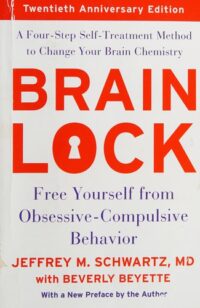
OCD can feel like your brain has jammed on a single channel and won’t let you change it. Jeffrey Schwartz named that experience “brain lock,” and he offers a way to loosen it. For a lot of readers, just having language for what’s happening is a relief.
What this book is about
Schwartz, a psychiatrist and OCD researcher, lays out a four-step method for responding to obsessions and compulsions. The steps help you recognize an urge as a symptom, understand where it comes from, shift your attention, and slowly loosen its grip. Brain-imaging work informs the approach.
Who this book may help
It may help if you:
- Get stuck on intrusive thoughts you can’t seem to shake
- Feel driven to check, wash, or repeat things to ease the discomfort
- Want a clear, memorable framework to lean on in the moment
- Are looking for a companion to therapy or a place to start
Key tools in the book
The four steps are the core: relabel the thought as OCD, reattribute it to a misfiring brain rather than reality, refocus onto a chosen activity, and revalue the obsession so it carries less weight. Real patient stories show the method in action.
Clinical strengths
The framework is easy to remember, which matters when you’re anxious and need something to hold. Schwartz treats readers with respect and hope, and the four steps give a sense of agency to people who’ve felt powerless against their own mind.
Limitations
The most strongly supported treatment for OCD is exposure and response prevention, which means facing the fear while resisting the ritual, usually guided by a trained therapist. Brain Lock complements that work but isn’t a full substitute for it. If your OCD is moderate or severe, please pair this with professional care.
My recommendation
I often suggest Brain Lock as an on-ramp, a way to understand the disorder and feel less alone with it. It works best alongside OCD therapy, where exposure work can do the heavier lifting. Read it, learn the steps, and use them as one part of a fuller plan.
This review is for general education and isn’t a substitute for professional care. If you’re struggling, a licensed mental health professional can help you find the right next step.
Dr. Joseph S. Weiss is a psychologist in Seattle, WA. He works with people dealing with anxiety, OCD, panic, insomnia, and phobias, drawing on CBT, EMDR, and other approaches with strong research behind them. He thinks of anxiety as a solvable problem.